Polish cuisine is one of the great cuisines of Central Europe, still relatively little known abroad but capable of surprising anyone who approaches it without preconceptions. It’s a cuisine built on the rigours of climate and the logic of preservation: smoked meats, fermented sauerkraut, hearty soups, dense stews and sweets that keep for weeks. Influences have accumulated over centuries — Ashkenazi Jewish, German, Ukrainian, Tatar, Austrian in southern Galicia — and are still recognisable in dish names, cooking methods and flavour combinations you won’t find elsewhere.
Eating well in Poland doesn’t require large budgets. In fact, one of the most appreciable characteristics of local gastronomy is the disproportion between quality and price: a complete meal with soup, main course and drink at a traditional Polish restaurant (restauracja polska) rarely exceeds 40-50 PLN (£7-10). At the Bar Mleczny, the subsidised popular version of local dining, you’ll spend even less. Street food is common especially in markets and seasonal fairs, whilst café and pastry culture has deep roots in historic cities like Cracow and Lviv, now in Ukrainian territory but for centuries an integral part of the same cultural sphere.
In this guide you’ll find the dishes really worth seeking out, with directions on where to eat them, how to recognise them on the menu and some curiosities that turn a meal into a cultural experience.
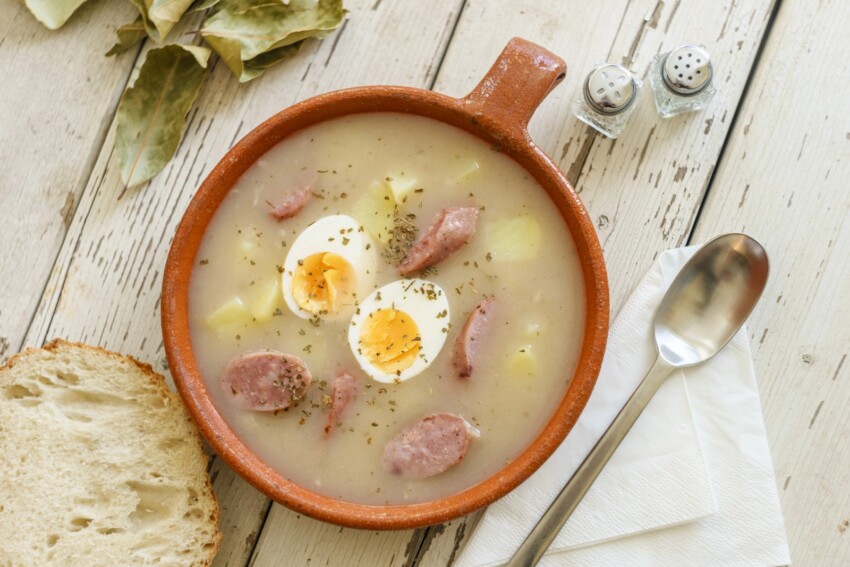
The żurek is the iconic soup of Polish cuisine and probably the dish worth starting any gastronomic journey through the country with. It’s a sour soup prepared with fermented rye flour, a process that takes several days and produces a broth with a sharp and deep flavour, impossible to replicate with industrial substitutes. It’s traditionally served with hard-boiled eggs, smoked white sausage (kiełbasa biała) and, in the most theatrical version, inside a hollowed-out bread roll that serves as an edible bowl.
Each region has its own variation: in Silesia żurek is denser and often contains potatoes; in Mazovia it’s lightened with cream; in the Easter version — the period when it’s traditionally most consumed — the sausage is replaced with ham. In tourist restaurants you’ll almost always find the bread-bowl version, which is also the most photogenic; in Bar Mleczny and local eateries it’s served in a simple bowl, without frills, often tasting better.
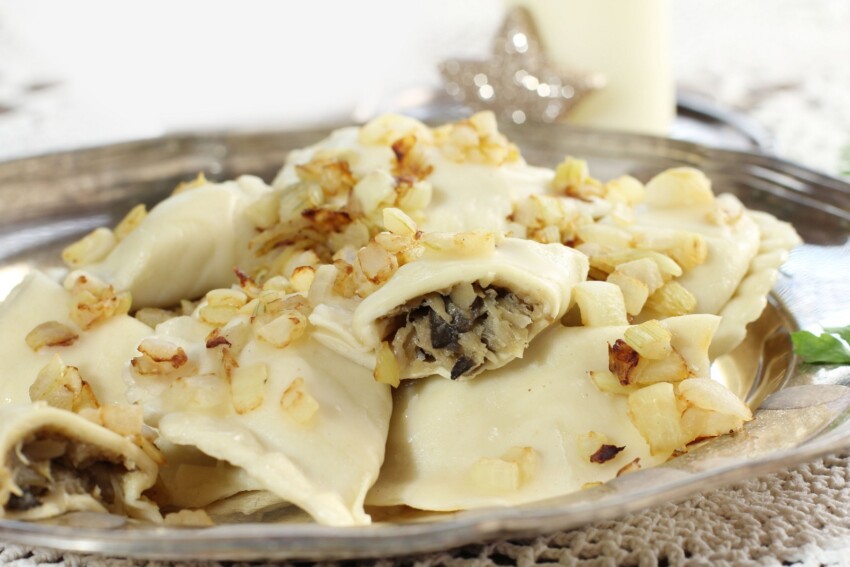
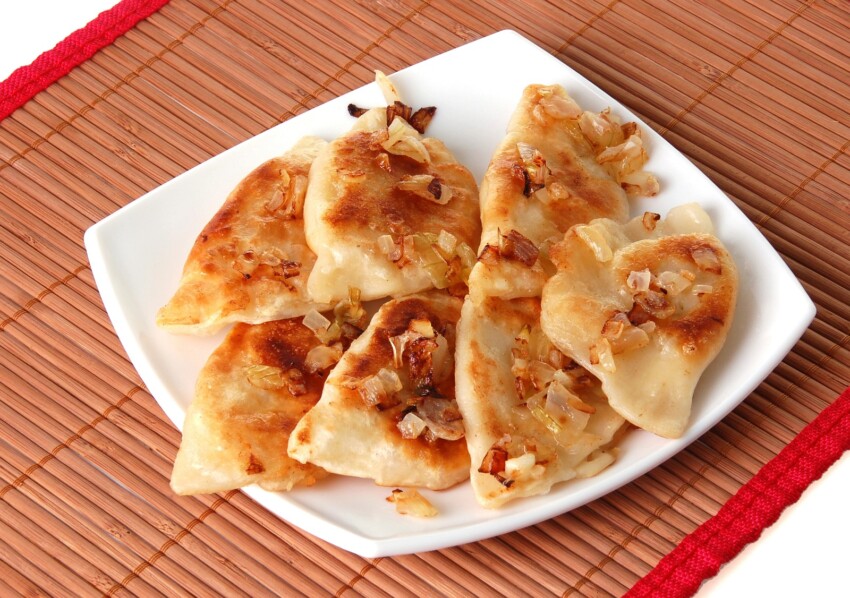
Pierogi are the most well-known Polish preparation abroad, often described simplistically as “Polish dumplings”, but the similarity to Italian filled pasta stops at the shape. The dough is thicker and softer, cooked in boiling water and then often fried in butter until lightly golden. The fillings vary enormously: ruskie (potatoes and curd cheese with caramelised onion, the classic), z kapustą i grzybami (sauerkraut and wild mushrooms, typical of winter and Christmas), z mięsem (mixed minced meat), z jagodami or z truskawkami (blueberries or strawberries, served with sour cream as a summer dessert).
The quality of pierogi is judged mainly by the dough: it should be elastic but not rubbery, thin enough not to overwhelm the filling flavour. Industrial frozen pierogi, unfortunately present in some tourist restaurants, can be recognised by their uniform dough with no irregularities. Hand-made ones always have small imperfections along the seal, a sign of artisanal work.
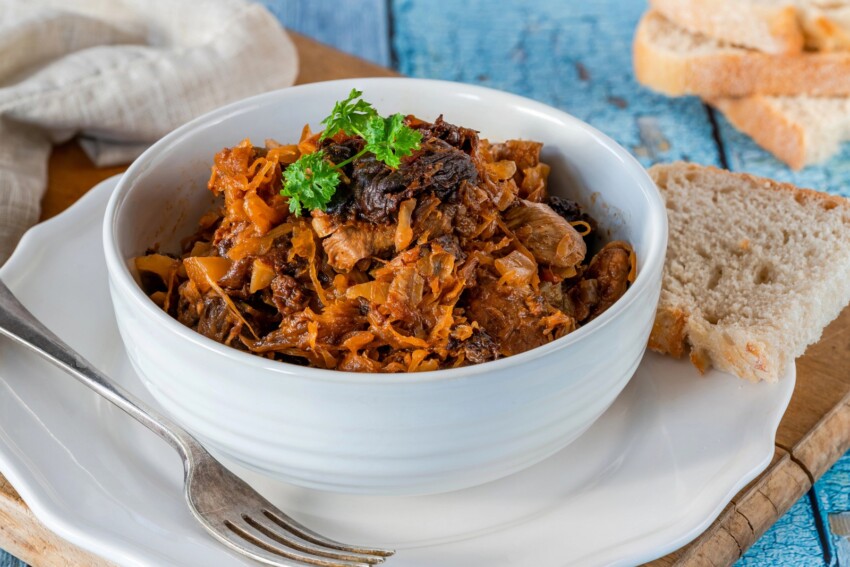
Bigos is the national stew par excellence, prepared with a mix of fresh and fermented sauerkraut, pork, smoked sausage, dried mushrooms, tomatoes and spices. Cooking happens slowly for hours, often for days: traditional bigos is reheated and stirred several times over the course of a week, and each day of rest intensifies its flavour. It’s one of those dishes that makes sense only in autumn and winter, when fermented sauerkraut reaches its aromatic peak and the body craves something dense and warm.
In restaurants it’s almost always served in generous portions as a main course, accompanied by dark bread or potatoes. A good version is recognised by its dark colour and semi-solid consistency: bigos that’s too liquid betrays hasty cooking. Some restaurants in Cracow and Warsaw offer special versions with added red wine or dried prunes, which soften the sourness of the sauerkraut with a sweet note.
Kotlet schabowy is the breaded pork cutlet in Polish cuisine, a direct cousin of the Austrian Wiener Schnitzel but with some substantial differences. The meat is beaten until extremely thin, breaded with fine breadcrumbs and fried in pork fat or oil until a golden, crispy crust forms. It’s served almost invariably with boiled potatoes dressed with butter and dill and with sauerkraut or fermented beetroot salad.
Kotlet schabowy is the quintessential Sunday lunch dish in Poland, the one every family prepares at least once a week. Finding it at a restaurant is simple: it’s on practically every Polish menu, from neighbourhood eateries to hotel restaurants. The difference between a mediocre and an excellent version lies almost entirely in the quality of the meat and the thinness of the beating: it must be thin enough to cook evenly without drying out in the centre.
Rosół is Polish chicken broth, technically a soup but culturally much more: it’s the Sunday dish, the convalescent meal, the Christmas lunch. It’s prepared by cooking whole chicken, carrots, celery, parsley root and leek for at least three hours over the gentlest heat, until you obtain a clear broth with an amber colour. It’s served with very thin vermicelli (nitki) or with small pasta dumplings (lane kluski), and the chicken meat is recovered as the main course.
In Polish restaurants rosół appears almost always as the soup course on the daily menu (obiad dnia), often at a token price. It’s the best way to understand the quality of a place’s cooking: a clear, fragrant and not greasy rosół is the sign of skilled hands and quality ingredients.
Gołąbki are cabbage leaves stuffed with minced meat and rice, cooked in the oven or on the stove and served in tomato sauce. The slow cooking and cabbage moisture create a soft, enveloping consistency that makes them one of the most loved comfort foods in Polish domestic cooking. Flaki is instead tripe in broth, a dish with an intense smell and powerful flavour that sharply divides those who love it and those who can’t approach it: it’s one of the oldest dishes in medieval Polish tradition and still today a must for connoisseurs of traditional cuisine.
Among the less well-known but worthy-of-attention dishes are kopytka, potato dumplings similar to Italian gnocchi but denser, served with melted butter and pork crackling; and zupa ogórkowa, pickled cucumber soup with potatoes and cream, with a pleasantly sour and refreshing flavour that works surprisingly well even in summer.
Poland has one of Eastern Europe’s richest bread-making traditions. Chleb żytni, dark rye bread, is the foundation of traditional diet: dense, slightly sour from natural fermentation, with a robust crust and compact crumb that stands up well to strong toppings. In the markets of historic cities you can still find artisanal bakers using sourdough starters decades old, with results difficult to match with industrial products.
Obwarzanek krakowski deserves separate mention: it’s the braided ring-shaped bread typical of Cracow, sold from characteristic orange carts scattered throughout the city. Crispy outside and soft inside, sprinkled with poppy seeds, sesame or coarse salt, it’s an economical and authentic snack that Cracovians eat at any time of day. Awarded Protected Geographical Indication status by the European Union in 2010, it can only be produced and sold as obwarzanek krakowski within the city’s boundaries. A detail you won’t find on the packaging: the original recipe calls for boiling the dough before oven-baking, the same process as the New York bagel with which it shares common historical origins in Ashkenazi Jewish tradition.
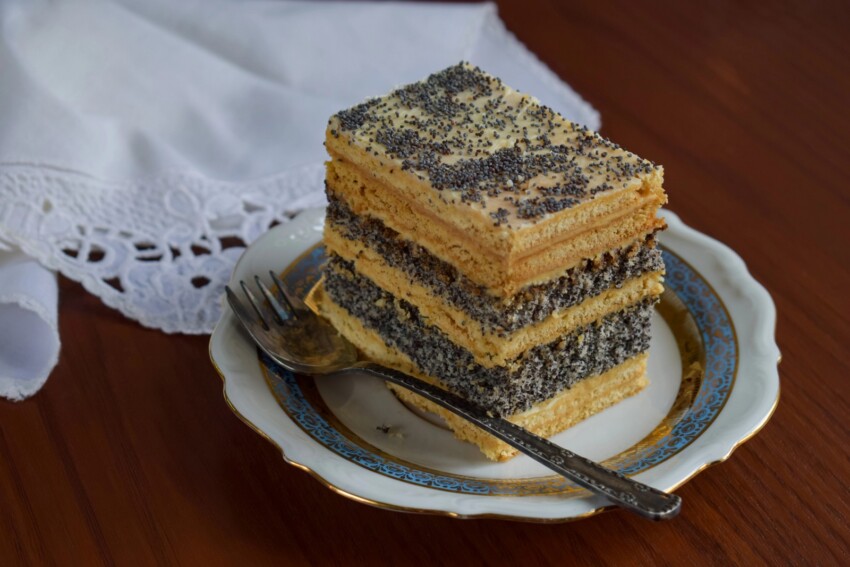
Polish cukiernia — pastry shops — have a long history and very high average quality, especially in cities with an Austro-Hungarian past like Cracow or cities that hosted Jewish communities with roots in Central European pastry tradition. The most representative sweet is sernik, Polish cheesecake prepared with twaróg (fresh curd cheese), eggs, sugar and often lemon zest: denser and less sugary than the American version, it’s conceptually close to Italian ricotta tart but with its own character.
Makowiec is a roll of leavened pastry filled with ground poppy seeds, honey and raisins: it’s the Christmas sweet par excellence, but you’ll find it in pastry shops for much of the year. Pączek is the Polish fried doughnut filled with rose hip jam and glazed with icing sugar: it’s consumed in industrial quantities on Fat Thursday (Tłusty Czwartek), the day when every pastry shop and supermarket in the country sells millions of pączki. Eating at least one during a visit to Poland, regardless of the season, is a must.
Bar Mleczny — literally “milk bar” — is one of the most fascinating and hardest-to-explain gastronomic phenomena to those who’ve never seen one. Born as subsidised public canteens by the State during the socialist period to guarantee hot and nutritious meals to the working class, they survived the end of communism and continue to operate today with partial public subsidy, maintaining prices that seem anachronistic compared to the cost of living in Polish cities.
The operation has remained unchanged since the seventies. You enter, take a tray, move along the counter pointing to the dishes you want (often without speaking, just pointing with your finger), pay at the till at the end of the line, wait for your number to be called and collect your plates at the counter. Tables are shared, chairs are plastic or rough wood, walls often adorned with formica panels or dated azulejos. The atmosphere is more like a school canteen than a restaurant, but that’s precisely the point.
The menu changes daily and is written on a blackboard or a laminated sheet hung on the wall: żurek, barszcz, rosół as soups; kotlet schabowy, gołąbki, kopytka, pierogi as mains and single dishes; fruit kompot and kefir as drinks. A complete meal — soup, main course, dessert and drink — rarely costs more than 20-25 PLN (£4-5). Quality is honest and sometimes surprising, because many Bar Mleczny still prepare everything from scratch in proper kitchens, without resorting to industrial semi-finished products.
The most famous and appreciated Bar Mleczny are found in Warsaw and Cracow. In Warsaw, Bar Mleczny Prasowy on Marszałkowska Street is perhaps the most iconic: frequented by students, pensioners and curious tourists in equal measure, it perfectly represents the original spirit of these places. In Cracow, Bar Mleczny Pod Temidą on Grodzka Square is just steps from the Rynek Główny and offers an economical alternative to the tourist restaurants of the historic centre. To find Bar Mleczny in the cities you visit, look for the sign reading “Bar Mleczny” or simply “Bar” followed by a name: they’re also marked on Google Maps with the specific category.
 Hotel
Hotel  Budget accommodations
  Apartments
  Family Hotel
  Luxury Hotel